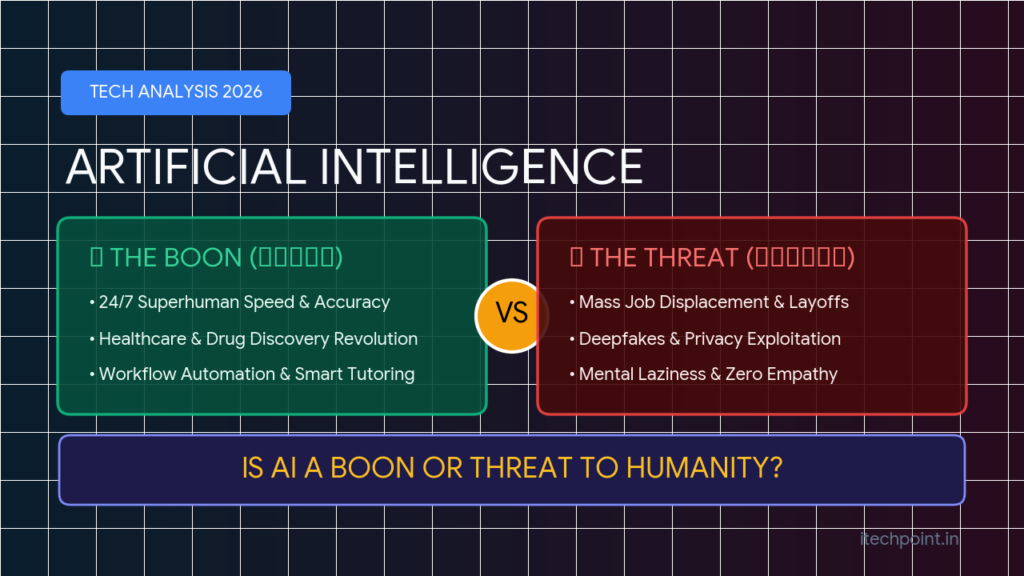
advantages and disadvantages of artificial intelligence If there is one field of technology that can be considered as the hallmark of the twenty-first century, it would be artificial intelligence. Over the last decade, mankind has witnessed “intelligent” creations ranging from language models like ChatGPT and Claude to self-driving cars, cancer scanners and even AI-powered robotic laborers and managers. The use of artificial intelligence forms an integral part of all spheres of contemporary society, ranging from work and leisure to communication and problem-solving.
“At its simplest, artificial intelligence is a computer program or an algorithm that can mimic the intellectual functions of a human being.” By using its programming and analyzing vast amounts of data, algorithms can be taught to recognize patterns, learn from its errors, form logical conclusions and even perform simple mathematical calculations faster than humans.
However as computers become more and more integrated in our daily lives and livelihoods, a difficult question looms on the horizon. Is artificial intelligence truly the key to unlock human potential? Or is it, ironically, a threat to jobs, creativity and even online privacy?
“The pros and cons of AI are an important topic for every individual who wants to succeed in the digital world.” “ Below, you can find my complete review, free from any biases, regarding the advantages and disadvantages of artificial intelligence.”
The Key Advantages of Artificial Intelligence
24/7 Operations
Hardly a day goes by where humans are not tired by the end of the day. We need to take a break and relax in order to be prepared for the next day. On average, humans need at least 8 hours of sleep and 1-2 hours of exercise to be able to maintain a steady workflow.
On the contrary however, computers and AI do not need to rest. AI systems, which are hosted on powerful server farms can operate 24 hours a day, 7 days a week with no drop in productivity. From combing through financial records to studying complex mathematics formulas, artificial intelligence can be relied upon to work tirelessly at whatever task is given to it.
Error-Free Operations
Human intelligence is prone to errors. It is extremely common for people to make simple mathematical errors or arrive at wrong conclusions due to tiredness, stress or other environmental factors
“This can lead to disastrous consequences especially in precision-based fields like aeronautics and orbital mechanics.” “Even the slightest calculation error when launching a rocket can cause it to crash down instead of reaching its destination.”
“Artificial intelligence is programmed to make calculations based on known variables and existing trends.” Provided that the data is properly formatted and errors are not caused by faulty programming, AI systems can essentially be completely error-proof.
Revolutionary Advancements in Healthcare
When it comes to industries that artificial intelligence has positively impacted, healthcare is far and away the biggest one. From disease detection to robotic-assisted surgery, AI is pushing the medical field into a new era.
For starters, physicians and surgeons can now use artificial intelligence to detect diseases in patients. By analyzing CAT scans and other medical images, AI algorithms are capable of spotting the early signs of many illnesses. As a result of faster diagnosis, a cure can now often be found in time to save patients’ lives. Some algorithms are even more accurate than humans at spotting malignant tumors!
Another area where AI is being applied is in the development of new drugs and treatments. In the past, coming up with a new drug was an extremely tedious process. It could take up to 10-15 years before a new drug is ready for release and distribution. With artificial intelligence, researchers can analyze proteins in viruses and find a fitting inhibitor to fight off the virus in a matter of hours, drastically reducing the time needed to find a cure.
In addition, robotic-assisted surgeries is another healthcare innovation that has allowed patients to heal faster with less pain. With AI-assisted robotic arms, even large incisions can be made with pinpoint, precision minimizing scarring and healing time.
Redundant Tasks Are Automated Away
In the modern workplace, a lot of employees are plagued with redundant tasks that do not stimulate them in any way. These tasks can include filling out Excel spreadsheets, logging in tickets into a helpdesk system or even just plain old paperwork.
Such automatable tasks can be offloaded onto AI, allowing human workers to focus on more important priorities. By cutting out redundant busy-work, human intelligence can be directed at more intellectually stimulating activities.
Risk Reduction in Hazardous Jobs
Human life is precious. Unfortunately, some industries demand that humans puts themselves at risk of injury or even death to keep up with production.
Deep mining operations, nuclear plant maintenence and even underwater pipeline repairing are all extremely risky jobs that can be replaced by AI-assisted robots or drones.
Rather than sending humans to dangerous terrains with unknown dangers, AI-powered robotic arms and drones can be sent into the frontlines to reduce human casualties.
More Accessible Learning Opportunities
Traditional classrooms have one, fundamental problem – there are only so many students per teacher. By virtue of the laws of supply and demand, the education level of a classroom can only be as good as its teachers. As such, brighter students often feel bored while their struggling classmates cannot keep up.
Artificial intelligence can change this paradigm by providing each student with an AI learning assistant. Such assistants can assess a student’s weaknesses and provide them with resources to address those problem areas. A student who is weak at higher-level calculus or computer science can message their AI tutor at any time of the day and ask them for a detailed explanation until they understand the topic.
Artificial intelligence has a lot of advantages. From faster work speed to smarter healthcare solutions, the benefits of artificial intelligence are truly amazing.
However, with every rose comes a thorn. There are also a lot of disadvantages and risks that comes with the rise of artificial intelligence. Let us take a look at some of the cons.
The Major Disadvantages and Risks of Artificial Intelligence
Global Workforce Displacement
The single biggest concern about artificial intelligence is the threat that it poses to jobs.” In the past, manual labor jobs have been automatized and replaced by machines”. As such, blue-collar jobs have decreased and white-collar jobs have increased.
Artificial intelligence poses a similar threat to white-collar jobs. While humans once had an edge in repetitive tasks such as coding and customer service, AI and machine learning algorithms have caught up to humans and are now capable of doing many of these jobs.
Intellectual Stagnation and Complacency
Just like muscles, human intellect can be strong or weak depending on how much it is exercised. When students and professionals use AI to answer their questions, write their essays or do their research, it reduces their learning and analytical capabilities.
In other words, if students rely too much on AI tutors, they may not be able to comprehend what they are taught. Same thing goes for professionals – if they are reliant on AI assistants, then they may not be able to write clear documents or even come up with sound arguments on the spot.
Deepfakes and Cybercrime Opportunities
Artificial intelligence enables the creation of deepfakes, realistic fake videos and audio files that can pass as real.
For example, a random citizen’s video can be edited to depict him saying something that he did not say. The same goes for CEOs, celebrities and politicians – their likeness can be replicated and abused for defamatory purposes. In a similar manner, criminals can use AI voice-cloning software to trick unsuspecting victims into giving up their life savings by calling them and pretending to be their family members.
Another way that bad actors can exploit AI is through deepfake spam articles. In this case, AI is used to generate thousands of spam articles with fabricated content. This can be used to spread misinformation and discredit important, life-saving research in both politics, medicine and other important fields.
Theft of Personal Data and Wealth Inequality
Modern AI requires huge amounts of data to be accurate. One of the ways that AI companies obtain this data is by scraping it from the internet. Web pages, blogs, forum posts, photography, artwork and many other things are scraped by AI to learn how to behave like humans. This is a problem because these methods violate the privacy of individuals who submit their work onto the internet without their knowledge.
Additionally, the interaction that users have with AI can be used against them. If a company collects data on how users act and respond to prompts, then they have valuable information that can be used to manipulate the general public or steal intellectual property.
Even more worrying is the issue of wealth inequality. Since training an artificial intelligence requires huge amounts of resources, only big corporations can realistically afford to own and operate an AI. This can lead to monopolization of the AI industry by a few tech giants, which can hurt the productivity of small-time businesses and even developing countries.
Summary Table: The Pros and Cons of AI
The complete pros and cons of AI can be summarized in the following table:
Now that we understand the pros and cons of AI, let us discuss whether artificial intelligence is a blessing or a curse to humanity.
Final Verdict: Blessing or Curse?
Artificial intelligence is not inherently good or evil. Rather, it is a tool that can be used by humans to achieve certain goals. The steam engine allowed the automation of manual labor. The computer allowed the automation of mathematical calculations. While artificial intelligence does the same thing for human thinking, it is perfectly normal for people to fear the consequences of this automation.
Unfortunately, the reality is that it is too late to reverse the course of history. AI is an inevitable part of the future and we must learn to adapt instead of resisting the change. With that being said, there are still measures that can be taken to prevent artificial intelligence from becoming a curse:
1. Proper laws must be implemented to prevent AI abuse. For example, AI-generated deepfakes should be heavily regulated and can be used for fraudulent activities.
2. People should invest in learning new skills to prepare themselves for the changing job market.
3. Important decisions must be left to humans, especially in matters of life and death.
If these measures are taken, then artificial intelligence can be truly be a blessing to humanity. Specifically, it can be used as a tool to enhance human thought and automate away mundane chores. Only when humans neglect their intellectual development and abandon their moral values will artificial intelligence truly become a curse.